Jama, Jamar and How Cubans Talk About Eating
Walk into a Cuban kitchen and most of the food has two names. One is the name printed on the menu. The other is what people say to each other while they eat.
What follows is a short glossary of the second kind, with pronunciation and honest notes about where each word came from and who actually uses it. Everything here can be traced to a dictionary, a published book, or usage any Cuban will confirm. That matters, because a lot of the Cuban slang for food floating around online is really slang from Spain with a Cuban label stuck on it. Those words are left out on purpose.
Jama and jamar, the center of Cuban slang for food
Jamar (ha-MAR) is the verb, and it means to eat. The Real Academia Española lists it as colloquial and traces it to Caló, the language of the Roma of Spain, whose roots run back to the Indo-Aryan languages of northern India. So the verb is not Cuban in origin. Spain uses it too. What Cuba did was build daily life around the noun.
Jama (HA-ma) is that noun: food, the meal, the thing in front of you. The dictionary marks this sense as Cuban and Nicaraguan, and in Cuba it is everywhere. The Cuban j is a light breath, closer to an English h than to the scraped sound of Madrid, so both words start soft.
Both are informal. Between friends they are neutral. Aimed at somebody you just met, or said in front of an older relative at the table, they can land as coarse. Listen for them before you try them.
Words for the food itself
Fruta bomba
Fruta bomba (FROO-ta BOM-ba) is papaya. Cubans do not call the fruit papaya, because in Cuba that word is vulgar slang for female genitals. The replacement is complete and it is not a joke. You ask for fruta bomba and nobody blinks. Elsewhere in the Caribbean the same fruit is lechosa, or papaya with no trouble attached to it.
Timba
Timba (TEEM-ba) is a thick bar of guava paste. Lay a slab of it on bread and you have pan con timba, one of the cheapest and most common sweets on the island. Add white cheese and the argument about whether it still counts starts. There is a popular story that the name comes from the English word timber, coined by British railway workers who thought the dark guava bars looked like creosoted crossties. Treat that as folklore. The versions in circulation date the encounter to the 1870s, but Cuba’s first railway, Havana to Bejucal, opened in 1837, and no dictionary supports the etymology.
Ajiaco
Ajiaco (a-hee-AH-ko) is a long-cooked stew of root vegetables and several meats, with pieces dropped in as they turn up. It is also the most quoted image in Cuban thought. On 28 November 1939 the anthropologist Fernando Ortiz read a lecture at the University of Havana called “Los factores humanos de la cubanidad,” published the following year in Revista Bimestre Cubana. In it he described Cuban culture as an ajiaco: a pot always on the fire, never finished, new ingredients going in at the top while the older ones break down and change the broth. Cubans still use the word that way in ordinary conversation.
Congrí and moros y cristianos
Rice and beans cooked together in one pot carry two names, and Cubans do not agree on them. Congrí (kon-GREE) is the eastern word, and traditionally it means the version made with red beans. Moros y cristianos (MO-ros ee kris-TYA-nos) usually means the black bean version, the name borrowed from the Moors-and-Christians pageants of Spain. Ortiz proposed that congrí came from Haitian Creole, from a word for bean plus the French riz, carried in by Haitian cane workers. That explanation gets repeated everywhere, including here, but as an attribution and not a settled fact. Plenty of Cubans will tell you the two names are interchangeable, and in Havana they often are.
Coffee has its own set of words
Cuban coffee vocabulary is exact about quantity and about who is drinking.
- Buchito (boo-CHEE-toh) — a mouthful, from buche, the amount you can hold in your mouth. A buchito de café is one short, sweet, strong serving.
- Cafecito (ka-feh-SEE-toh) — the same idea, the single portion, sugar already whipped into the first drops.
- Colada (ko-LAH-da) — a large cup of that coffee, sent out with a stack of tiny plastic cups so a group can split it. A colada is not a size for one person.
- Cortadito (kor-ta-DEE-toh) — espresso cut with hot milk, longer than a buchito, made to be sat with.
One honest note about geography. The colada as a thing you carry back to a room full of coworkers is as much a Tampa and Miami habit as a Havana one. It grew into its current form on this side of the water. A colada is on our list for that reason.
Expressions where the food is not the point
- Arroz con mango (a-RROS kon MAN-go), literally rice with mango — a mess, a tangle, a situation where two things that do not belong together have been stirred into one. “Se formó un arroz con mango” is how you say it all came apart. Venezuelans use it too.
- Comerse un cable (ko-MER-seh oon KA-bleh), to eat a cable — to be broke, out of work, scraping. The picture is hunger bad enough to chew wire. Cubans, Venezuelans and Panamanians all say it.
- Dar muela (dar MWEH-la), to give molar — to talk and talk. The Diccionario del español de Cuba defines muela as a long, tedious conversation. Meter muela tilts the same image toward persuasion: talking somebody into something, working an angle with words.
Two more verbs belong in any honest list, and neither is funny. Resolver (rre-sol-VER) and inventar (in-ven-TAR), to resolve and to invent, are what Cubans say instead of get and cook when the thing being obtained is scarce. You resolve a chicken. You invent dinner out of whatever is in the house. The usage hardened during the Período Especial after 1991 and never went away. Claudia González Marrero gathered the whole register in “Vocabulario cubano de crisis y cocina” (Rialta Ediciones, 2024), a dictionary of the language that shortage produced. If you borrow resolver in front of someone who lived those years, know what you are borrowing.
Small words around the table
- Jaba (HA-ba) — the bag. The Real Academia marks the sense of a cloth or plastic carry bag as Cuban. Your food to go rides home in a jaba.
- Pomo (PO-mo) — a plastic bottle, or a glass jar. In Cuba a pomo de agua is a water bottle, never a doorknob.
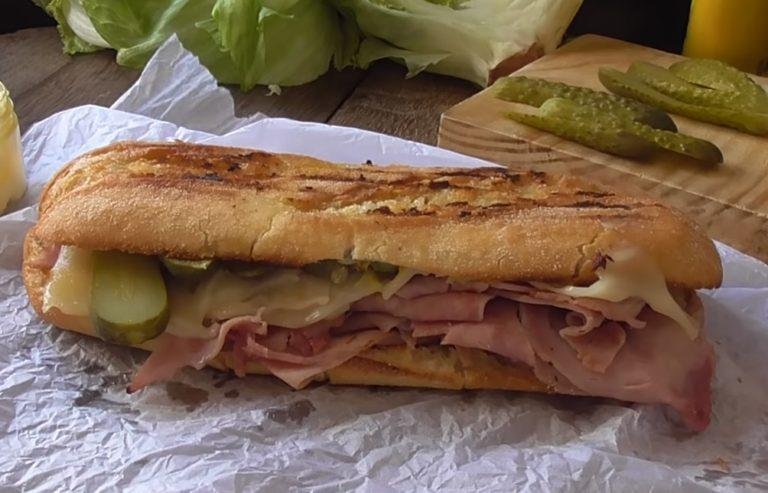
- Sanguich (SAN-gwich) — sandwich. The standard spelling is sándwich. Cuban pronunciation collapses it, and the spelling sanguich turns up on handwritten signs all over the island.
- Provecho (pro-VEH-cho) — short for buen provecho, said to strangers as you pass their table, and said back. It costs nothing and it gets noticed.
Two habits matter more than any single word. The first is “ya comí,” I already ate, the standard polite refusal when a Cuban household starts putting plates in front of you. It is understood as an opening move, not a final answer, and the correct response from the host is to serve you anyway. The second is what Cuban mouths do to consonants. The s at the end of a word softens or disappears, and the d in the -ado ending drops out, so pescado becomes pesca’o and asado becomes asa’o. That is not sloppiness. It is standard Caribbean Spanish, shared with Puerto Rico, the Dominican Republic, and the coasts of Venezuela and Colombia.
Chef’s notes
- Listen before you speak. Jama and jamar are friend-to-friend words. Nobody will correct you when you get the register wrong, but they will hear it.
- Never ask for papaya in a Cuban kitchen. Fruta bomba, every time.
- Put the stress where it belongs. Ha-MAR, not HA-mar. Cuban Spanish moves fast and swallows consonants, so the stressed vowel is the part that survives.
- Do not translate the idioms word for word. Arroz con mango has nothing to do with fruit, and nobody has ever eaten a cable.
- Say provecho when you pass a table. It is the one item on this list that still works if you get everything else wrong.
- You do not need any of this to order. Point, or say it in English. Both get heard here all day.
Most of this vocabulary attaches to one plain kind of plate: something roasted or fried, rice, beans, something sweet after. If you would rather order it as one thing instead of assembling it piece by piece, look at the special combos. The rest is on the menu. We are at 5555 S 78th St in Tampa and the number is (813) 450-2176. Bring the vocabulary. We will fill the jaba.