Empanada, pastelito or croqueta: what to grab at the counter
Three things sit in the case that look like cousins. They are not. An empanada, a pastelito and a croqueta are built from three different materials, by three different methods, and they belong to three different moments of the day. Once you know which is which, choosing takes about ten seconds.
Here is the decoder, from the outside in.
The three-second version
- Empanada — one plain sheet of dough, folded into a half moon and sealed along the curve. Savory filling. Closest thing to a small meal.
- Pastelito — puff pastry, flat and usually square, built from dozens of thin layers, with a shine of sugar syrup brushed over the top. Sweet or savory. Coffee food.
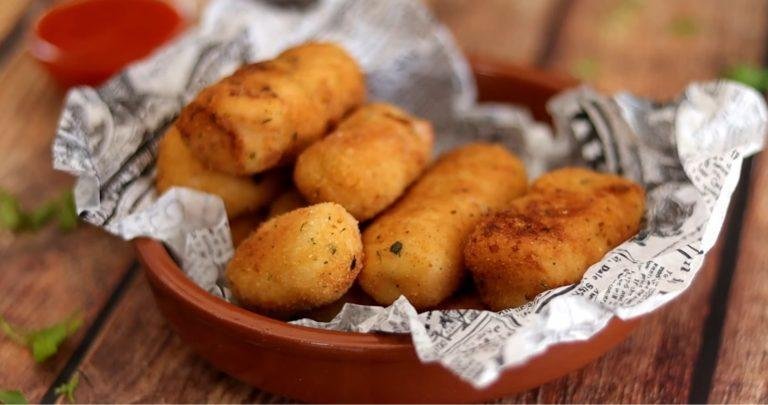
- Croqueta — no dough at all. A short cylinder of thick, cooled béchamel, breaded and fried. Always savory. Eat it hot, two or three at a time.
That covers most of it. The rest is detail worth having.
The empanada is one dough, folded once
The dough is a single plain sheet: wheat flour, fat, a little liquid, rolled thin and cut into a circle. Filling goes on one half, the other half folds over, and the curved edge gets crimped shut with a fork or pinched by hand. Nothing about it is layered. Bite through and you meet one thin wall, then filling.
Cuban empanadas are usually fried. Frying gives the crust small blisters and a firm snap at the sealed rim, where the dough doubles on itself. Baked ones come out paler and softer, more like a pie crust than a shell.
The fillings run savory. Ground beef picadillo cooked down with onion, pepper, cumin and olives is the standard. Shredded chicken and ham with cheese are common too. Some counters keep a guava one, and that is exactly where people start mixing up empanadas and pastelitos.
The name comes from the Spanish verb empanar, to wrap in bread. Filled pastries are much older than the word, but the Iberian paper trail is solid: Llibre del Coch, the Catalan cookbook printed in Barcelona in 1520 and attributed to Mestre Robert, cook to the King of Naples, already contains empanada recipes. A Castilian translation followed in 1525 and carried the form across Spain. From there it travelled with everyone who left, and each country reshaped it. Galicia bakes a large flat pie and cuts it into squares. Argentina bakes small wheat pockets with a rope-twisted edge. Cuba fries a half moon and eats it standing up.
The pastelito is many layers with sugar on top
A pastelito is made from hojaldre, laminated dough. A block of fat is wrapped inside the dough, rolled flat, folded, rolled again, and folded again, several times over. Each fold multiplies the sheets of dough and the films of fat between them. In the oven the water in the dough turns to steam and forces those sheets apart.
That is the whole difference in texture. A pastelito shatters and drops flakes down your shirt. An empanada gives way in one clean bite. Same flour, different architecture.
Shape is usually flat and square or rectangular, often with slits cut in the top to let steam out, and almost always finished with simple syrup brushed on while it is still hot. The syrup dries glossy and slightly tacky. That glaze is the Cuban signature, and it is why your fingers stick.
Fillings go both directions. Guava paste is the classic, guava with cream cheese right behind it, then cream cheese on its own, coconut, and savory versions filled with seasoned ground beef or ham. Because a pastelito can be sweet or savory, sweetness is a poor way to sort your order. Time of day works better.
About the shape code
You will hear that the shape of a pastelito tells you what is inside it: square means guava, round means meat, a certain fold means cheese. Treat that as a house habit, not a rule. It changes from bakery to bakery and from city to city, and we are not going to print it as fact when we cannot confirm it holds anywhere but one kitchen.
Ask what is in the case. It takes two seconds and it is the only method that works every time.
The croqueta has no dough anywhere
The croqueta is the outlier. There is no pastry in it at all.
It starts as a very thick béchamel. Fat and flour cooked into a paste, then milk beaten in a little at a time until the mixture is stiff enough to stand a spoon in. Finely ground ham or chicken goes in, sometimes a grating of nutmeg, sometimes onion cooked soft first. The mix is spread in a tray and chilled until it is cold and firm. That chilling step is the one people skip at home, and it is why home croquetas split open in the oil.
Cold, the paste is rolled into short cylinders, passed through beaten egg, then through breadcrumbs or cracker meal, and fried. What comes out is a thin crisp shell around a filling that is nearly liquid while hot. It sets back up as it cools, so a croqueta eaten ten minutes late is a different and much sadder food. Eat them first.
The name comes from the French croquer, to crunch. Croquettes were in French cookery by the eighteenth century. Spain took up the béchamel version in the nineteenth and turned it into everyday home cooking, and it reached Cuba from there. On the island it became the standard afternoon snack and the base of pan con croqueta: two or three croquetas pressed into a bread roll, which sounds odd until you have eaten one.
When each one is eaten
The clock sorts these better than the ingredients do.
- Early morning. Pastelito, with strong coffee. This is the standard Cuban breakfast at a counter, and either a sweet or a savory one works at that hour.
- Mid-morning and late afternoon. Croquetas. This is the merienda slot, the small hold-you-over between meals.
- Midday, actually hungry. Empanada. It is the heaviest of the three, it holds together in one hand, and it survives a bag.
- After dinner. Sweet pastelito, guava or cream cheese.
Chef’s notes
- How many to order. One empanada is a light lunch. Two pastelitos with coffee is a breakfast. Three croquetas is a snack, six is a meal.
- Buying for a group. Mix all three and expect the croquetas to go first. They always do.
- Holding time. Empanadas travel best. Pastelitos are at their peak the same day, because the syrup glaze softens the top layers overnight. Croquetas want to be eaten right away.
- Reheating. Oven or toaster oven, 350°F, five to eight minutes, no cover. Never the microwave. Puff pastry goes limp, the empanada crust turns to leather, and a microwaved croqueta stays soft outside while the middle gets hot enough to burn your mouth.
- What to drink. Black coffee cuts the fat better than anything else. A colada is the usual choice when several people are sharing.
- Feeding kids. Cheese or guava pastelito. Less filling temperature to worry about than a croqueta straight from the fryer.
- Worth knowing. Croquetas contain milk, wheat and egg by definition, since the body is béchamel and the coating is egg and breadcrumb. There is no dairy-free croqueta.
Standing at the case
Ask yourself one question: am I eating a meal, a snack, or something with coffee. Meal is the empanada. Snack is the croqueta, ordered in threes. Coffee is the pastelito, and you decide sweet or savory when you see what is in the case that day.
All three sit alongside the sandwiches, the platters and the sides on our menu, and all three order for pickup. If you are coming in early, take the pastelito and the coffee. If you are coming in at noon, take the empanada. Either way, order the croquetas hot and eat them in the car.