The African layer of Cuban cooking
Cuban food usually gets explained in a hurry. Spanish base, a little Indigenous, a little Chinese, a little African. That last item gets one sentence and a mention of okra, and then the conversation moves on. It deserves more room. Some of the oldest habits in a Cuban kitchen came from West and Central Africa, carried by people who had no say in the crossing, and they are still on the table.
The scale is the place to start. Historians working from the Trans-Atlantic Slave Trade Database put the number of Africans disembarked in Cuba at close to 800,000, the great majority of them in the nineteenth century, when sugar turned the island into the busiest slave market in the Spanish empire. Abolition came in 1886, after a six-year transitional arrangement called the patronato. That is late. African-born cooks were working in Cuban kitchens within living memory of people who saw the twentieth century.
Cubans sorted the arrivals by what they called nations: Congos from West Central Africa, Bantu speakers; Lucumí from Yorubaland; Carabalí from the Bight of Biafra; Arará from the old kingdom of Dahomey. Those are colonial labels, blunt and imprecise, and historians handle them with care. They still tell you something. The Bantu share was large, and the Bantu mark on Cuban cooking is the one you can point at directly.
Quimbombó, and a word that crossed twice
Okra is an African plant, domesticated somewhere in the belt that runs from West Africa toward Ethiopia, and it reached the Americas with the slave trade. Cubans did not borrow a Spanish name for it. They kept the African one. Quimbombó comes from Bantu: ki ngombo in Kimbundu, ochinggombo in Umbundu, both spoken in what is now Angola. The same root produced gumbo in Louisiana. Two ports, two colonial languages, one word.
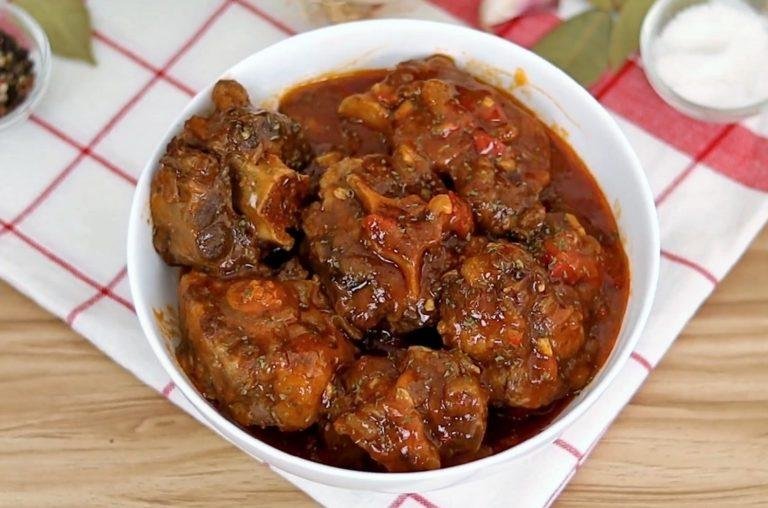
Quimbombó criollo is a stew, not a side dish. Pork or salted meat browns first, then a sofrito of onion, garlic and green pepper, then tomato, broth, and the okra cut into rounds. Cooks who want less of the vegetable’s slip add vinegar or sour orange early, or dry the cut okra before it goes into the pot. In many households the stew finishes with bolitas de plátano: small dumplings of grated green plantain, rolled in the palm and dropped in to cook through in the last ten minutes. An African vegetable, a Spanish sofrito, and a dumpling made from a fruit that came by way of the Canary Islands, all in one pot. That is the whole argument in miniature.
Quimbombó also has a life outside the kitchen. In Regla de Ocha, the Afro-Cuban religion built on Yoruba practice, it is one of the dishes associated with Changó. Food and worship were not separate departments. Some recipes survived precisely because they had somewhere to go besides dinner.
Fufú, and the habit of pounding
Across a wide stretch of West and Central Africa the everyday starch is pounded. Boiled cassava, yam or plantain goes into a tall wooden mortar and is worked with a heavy pestle until it turns smooth and elastic, then torn off in pieces and dipped into soup. The Akan word fufuu, from present-day Ghana, is the source most often given for the Cuban fufú, though other researchers point toward Kikongo and related Bantu terms for mashing. The route the word took is argued. The practice behind it is not.
What Cuba had in quantity was plantain. Green plantain boils soft in twenty minutes and mashes readily. Fufú de plátano, called machuquillo in much of the island, is green plantain boiled and then mashed with garlic, hot pork fat, broken chicharrón, and enough of the cooking broth to keep it loose. In most Cuban homes it is not pounded in a mortar at all; it is mashed in the pot with a wooden spoon. That is what creolization looks like up close. The ingredient changes, the tool changes, the idea holds.
The same idea produced mofongo in Puerto Rico, where the mortar survived, and mangú in the Dominican Republic. Three islands, three names, one ancestor. Cuba kept the mortar for other work: the wooden pilón in which garlic, salt and cumin get crushed for mojo is the same tool doing a different job, and it is still the only sensible way to get garlic to give up what it has.
The beans, the roots, the birds
Frijoles de carita, black-eyed peas, are cowpeas, an African crop. In Cuba they are soaked, rubbed to remove the skins, and ground into a batter for bollitos, fried in small spoonfuls until they puff and darken. Anyone who has eaten akara in Nigeria or acarajé in Bahia will recognize them on sight. They are one dish under three flags. Olelé, the same batter steamed in a wrapper instead of fried, also survived in Cuba, mostly inside religious households.
Ñame is a true yam, of the genus Dioscorea, African and Asian in origin, and it crossed the Atlantic first as ship provisions and later as a crop. It sits on Cuban tables beside malanga and boniato, both of which are American plants. The vianda basket is itself a mixture, not a single inheritance. Guinea fowl, the gallina de guinea, carries its origin in its name; so does ajonjolí, sesame, and so does the tamarind that flavors cold drinks.
Coffee arrived in eastern Cuba by another African-descended route. French planters and the enslaved people they brought with them, fleeing the Haitian Revolution after 1791, built the coffee estates of the Sierra Maestra; the ruins are now a UNESCO World Heritage site. The same migration, reinforced by Haitian cane cutters in the twentieth century, is the usual explanation for congrí in Oriente. The name is generally traced to Haitian Creole, congo for a bean and riz for rice, though that etymology is not settled. In eastern Cuba congrí means red beans cooked together with the rice; in the west, moros y cristianos means black beans done the same way. Plenty of Cubans use the two names interchangeably and then argue about it.
Where it was kept alive
Foodways do not survive on their own. They need a place. In the countryside that place was the conuco, the provision plot enslaved people worked for themselves on Sundays and holidays, growing plantain, yam, malanga and beans and selling what was left over. Plantations ran on the system because feeding people from the estate was cheaper than importing food. The side effect was that African crops and African cooking stayed in the hands of the people who knew them best.
In the cities the place was the cabildo de nación, the mutual-aid society organized by African nation, licensed by the colonial government and tolerated because it looked harmless. Cabildos held funds, held funerals, held drums, and cooked. The Día de Reyes procession in Havana, the one day of the year the cabildos took the streets, was ended by the authorities in 1884, but the houses continued as religious houses and the ritual kitchen continued with them: corn paste, bean paste, okra, particular dishes for particular deities, made in particular ways.
And in the large colonial households, the cooks were African and Afro-Cuban women. The dishes now filed under Spanish inheritance were made by their hands for generations. Technique passes through the person doing the work, not the person who wrote the menu.
Ajiaco, and why the image stuck
In a lecture given in 1939 and published the following year, the Cuban anthropologist Fernando Ortiz compared his country to an ajiaco: an open pot that never gets emptied, where new ingredients go in at the top while what sits at the bottom has been cooking for centuries. Ortiz had spent decades on Afro-Cuban subjects, beginning with Los negros esclavos in 1916, and in 1940 he coined the term transculturación for what happens when cultures meet and both come out altered.
The image has been overused since, but it holds up better than the usual list of influences, because it gets the direction right. Nothing here was added on top of a finished Spanish dish. The layers cooked together for four hundred years, and the African layer is not the garnish.
You can taste a good part of this without knowing any of it. Kiki’s is a Cuban restaurant at 5555 S 78th St in Tampa, and the plate we serve carries the same history: plantains from the fufú and dumpling tradition, black beans from the pot that has been on the fire since the sugar years. The rest of it is on the menu.