Kitchen Secrets with Our Cuban Chef – Arroz con Pollo
Two things go wrong with arroz con pollo, and neither one is about seasoning. The first is gummy rice, where the grains swell into a single soft mass. The second is dry, stringy chicken. Both are decided before the pot goes on the heat.
Gummy rice is a grain problem. Cuban arroz con pollo wants medium-grain rice, the short, fat kind sold as Valencia rice or as arroz para paella. It drinks a lot of liquid and still holds its shape. Long-grain works too and gives a drier, more separate result that some families prefer. What does not work is arborio or any short-grain risotto rice. Those varieties are bred to shed starch into the liquid, and that starch is exactly what turns the pot into porridge. Rinse whatever rice you use under cold water until the water runs mostly clear, then drain it well. That one step pulls off the loose surface starch and does more for the texture than anything you do later.
Dry chicken is a cut problem. Boneless breast is done in about twelve minutes. The rice needs twenty under a lid. The two are not compatible, and the breast always loses. Use bone-in, skin-on thighs. They take the full simmer without tightening, the bones give the liquid body, and the fat rendered from the skin becomes the base of the sofrito. If someone at your table only eats white meat, lay one bone-in breast half in with the thighs and pull it out ten minutes early.
The color question: bijol, not saffron
The yellow in most Cuban home kitchens comes from bijol. It is a fine powder built on annatto – bija or achiote, the brick-red seed of the achiote tree – cut with corn flour and a little cumin. It colors hard, so one teaspoon is plenty for two cups of rice, and it carries almost no flavor of its own beyond a faint earthiness. That is the point. It is a coloring, not a spice blend.
Saffron is the traditional coloring in Spain, and it shows up in restaurant versions and in Cuban families with a Spanish grandmother. It is not the everyday choice, mostly because of what it costs. If you use it, crumble a generous pinch into the warm broth and leave the bijol out. Saffron is floral and specific; it changes the dish rather than just tinting it.
With neither on hand, warm a teaspoon of ground annatto in the oil for thirty seconds before the vegetables go in, or steep whole annatto seeds in the oil and strain them out. Turmeric is the substitute most people reach for. It does produce yellow, but it brings a mustardy bitterness that does not belong here, so use half as much.
Ingredients
- 6 bone-in, skin-on chicken thighs (about 3 lb / 1.4 kg)
- 2 tablespoons sour orange juice (or 1 tablespoon lime juice plus 1 tablespoon orange juice)
- 6 garlic cloves, minced, divided
- 2 teaspoons ground cumin, divided
- 2 teaspoons dried oregano, divided
- 2 teaspoons kosher salt, plus more to taste
- 1 teaspoon black pepper
- 1/4 cup olive oil
- 1 large yellow onion, diced small
- 1 green bell pepper, diced small
- 1/4 cup tomato sauce
- 2 bay leaves
- 2 cups medium-grain rice (Valencia type), rinsed and drained well
- 1 teaspoon bijol, or 1 teaspoon ground annatto
- 1 bottle (12 oz) light lager beer
- 2 cups chicken broth, warm
- 1/2 cup frozen sweet peas, thawed
- 1/2 cup jarred roasted red pepper strips (pimientos), drained
Method
- Pat the thighs dry. Toss them with the sour orange juice, half the garlic, 1 teaspoon cumin, 1 teaspoon oregano, the salt and the black pepper. Leave them 30 minutes at room temperature, or covered in the refrigerator overnight.
- Heat the olive oil in a wide heavy pot or caldero, 5 to 6 quarts, over medium-high heat. Brown the thighs skin side down in two batches, about 6 minutes, until the skin releases from the pot on its own. Turn and give them 3 minutes on the second side. Move them to a plate.
- Pour off all but about 3 tablespoons of fat. Lower the heat to medium, add the onion and green pepper with a pinch of salt, and cook 10 minutes, stirring, until soft and just starting to color at the edges.
- Add the remaining garlic and cook 1 minute. Add the tomato sauce, bay leaves and the remaining cumin and oregano. Cook 2 minutes, until the sauce darkens and the oil separates around it.
- Add the drained rice and stir 2 minutes, until every grain is coated in fat and the rice looks glossy.
- Stir in the bijol, then pour in the beer. Let it boil hard for 2 minutes.
- Add the broth. Taste the liquid and correct the salt now; it should taste slightly saltier than you want the finished rice to be.
- Nestle the thighs into the pot skin side up, along with any juices from the plate. The liquid should just cover the rice, with the chicken sitting partly above it.
- Bring to a strong simmer, then drop the heat to its lowest setting and cover tightly. Cook 20 minutes without stirring and without lifting the lid.
- Check the rice. If it is tender and the liquid is gone, move on. If there is standing liquid, uncover and cook 3 to 5 minutes more. If the liquid is gone but the grains are still hard, add 1/4 cup hot broth, cover and give it 5 minutes.
- Scatter the peas and the roasted pepper strips over the top, replace the lid, take the pot off the heat and rest it 10 minutes.
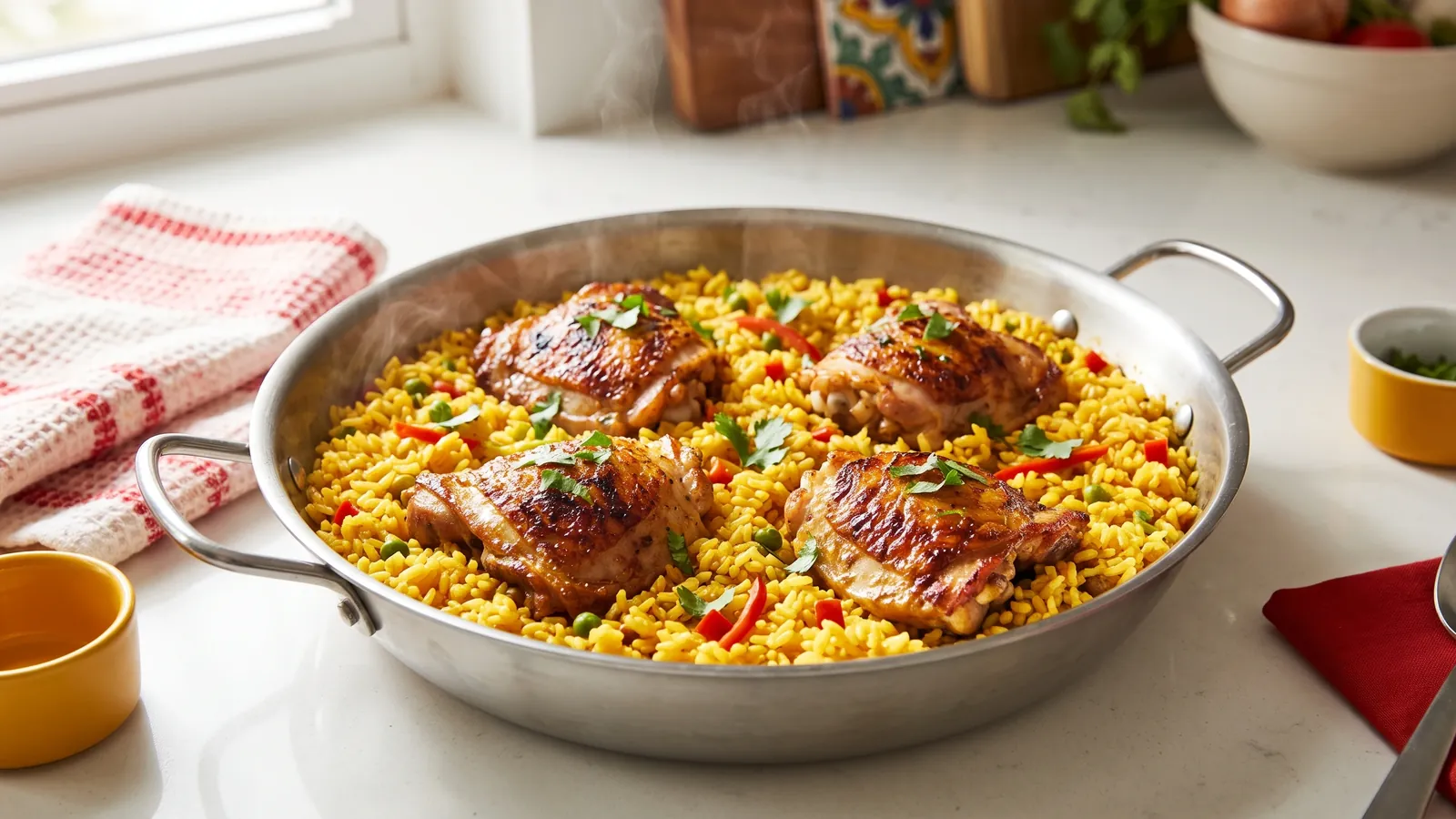
- Remove the bay leaves. Fluff the rice with a fork, working from the edges toward the center so you do not mash the grains. Serve straight from the pot.
Chef’s notes
Beer or broth
The beer is not decoration. The alcohol is gone within two minutes of boiling; what stays is a thin malt sweetness and a bitterness that cuts the fat coming off the thighs. Use a plain light lager, not an IPA – hops concentrate as the liquid reduces and go harsh. If you skip the beer, use 3 1/2 cups of broth in total and add a tablespoon of dry white wine to put some acidity back.
The lid does the work
Once the liquid is in, stop touching the rice. Stirring drags starch off the grains and suspends it in the liquid, which is the same mechanism that makes risotto creamy and this dish sticky. Lifting the lid vents the steam that is cooking the top layer. If your lid does not seal well, lay a sheet of foil over the pot and press the lid down onto it.
When it comes out wrong
There are only two failures at the twenty-minute mark, and each has one fix. Hard grains with a dry pot means it needed more liquid: add 1/4 cup of hot broth, cover, five more minutes on low. Soft grains sitting in liquid means too much: uncover, raise the heat a little, and let it drive off for three to five minutes while you watch the bottom.
A la chorrera
The looser, soupier version of this dish is called arroz con pollo a la chorrera. It is the same pot with roughly an extra cup of liquid, served in a shallow bowl instead of mounded on a plate. Add the extra broth during the rest, not at the start, so the rice does not overcook while it absorbs.
Keeping it
Refrigerate up to three days. Reheat covered over low heat with a splash of broth, or press it into a hot oiled skillet and leave it alone until the underside crisps. That crust is the best part of the second day.
On the plate
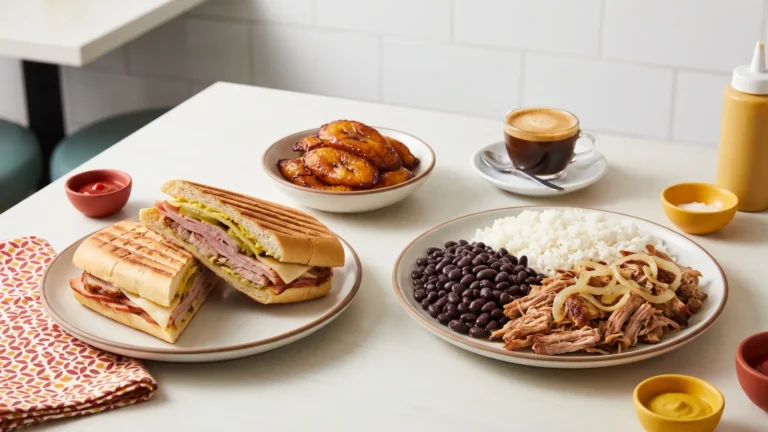
Plated, the dish is a mound of rice with a thigh set on top, pimiento strips crossed over the skin, and sweet plantains on the side. The plantains are not a garnish. Their sugar lands against the salt, the cumin and the fat of the chicken, and the plate feels finished in a way it does not without them. A wedge of lime is enough acid to reset your palate between bites. Black beans alongside turn it into a full Sunday meal, though the rice has enough going on to stand by itself.
If you want the parts without the pot, our yellow rice and plantains are both on the ordering list, and the rest of the menu is there for pickup whenever you would rather not stand over a caldero.