Chino-cubano: the Chinese Cubans who changed the menu
Order rice at a Cuban restaurant almost anywhere and sooner or later you will be handed fried rice: long grain rice tossed in a hot pan with ham, shrimp, egg, scallion and soy sauce. It sits on the menu between the black beans and the plantains as if it had always been there. It has not. It came off ships from Guangdong, and the men who brought it were not travelers. They were under contract.
The contract, 1847 to 1874
Spain had built Cuba into the largest sugar producer in the world on the labor of enslaved Africans. British pressure had made that traffic illegal, though ships kept landing people illegally into the 1860s, and the planters went looking for another supply of workers. They found it in southern China, where war, rebellion and hunger had left men willing to sign almost anything.
The first two shiploads reached Havana in 1847. Between them the Oquendo and the Duke of Argyle carried just over five hundred men from the port of Amoy, today Xiamen. Over the next twenty-seven years roughly 125,000 Chinese men were shipped to Cuba, most from the Pearl River Delta counties of Guangdong, and most through Macao. Women were a fraction of one percent of the total.
The contract ran eight years at four pesos a month, with food and clothing. That was the paper. In practice the contracts were auctioned in Havana like cargo, the men were worked in the cane fields and the sugar mills beside enslaved Africans, and refusal was answered with the whip and the stocks. Estimates of deaths on the crossing sit near one in ten, and the worst ships were far worse than that. When the eight years ended, planters had ways of forcing a man to sign again.
In 1874 the Qing government sent an investigating commission to the island under the official Chen Lanbin. It collected more than a thousand depositions and written petitions from Chinese laborers in Cuba. The report it published two years later is one of the bluntest labor documents of the century, and it ended the traffic. The last shipments landed in 1874, and a treaty between Spain and China formalized the close in 1877.
From the cane field to the corner fonda
The men who reached the end of a contract had no land, no family on the island and very little Spanish. Most walked toward the cities. They opened laundries, fruit stands, small groceries and fondas, cheap eating houses with a counter, a few tables and one fixed plate of the day. Others rented ground on the edge of Havana and grew vegetables for the city markets, work Chinese families held for generations.
A second wave came from California in the 1860s and 1870s: several thousand Chinese leaving the violence and the exclusion laws of the United States, arriving with English, savings and experience running a business. They anchored the blocks around Zanja, Dragones and Rayo streets. Havana’s Barrio Chino grew into one of the largest Chinatowns in the Americas, with mutual aid societies, theaters, Chinese-language newspapers and restaurants that ran several floors up.
Because so few Chinese women came, the families were mixed from the first generation. The painter Wifredo Lam, born in Sagua la Grande in 1902, was the son of a Cantonese immigrant father and an Afro-Cuban mother. Chinese Cubans also fought the wars of independence. José Bu Tak served as an officer in the Liberation Army and was later naturalized as a Cuban citizen. The monument raised in Vedado in 1931 carries the line credited to Gonzalo de Quesada: that no Chinese Cuban was ever a deserter, and none was ever a traitor.
What changed on the plate
The kitchen change was slow and it was practical. Chinese cooks ran fondas that had to feed Cuban customers, so they cooked Cuban food most of the day. What they added was their own: fried rice, chop suey, chow mein, and a bottle of soy sauce on the shelf next to the vinegar.
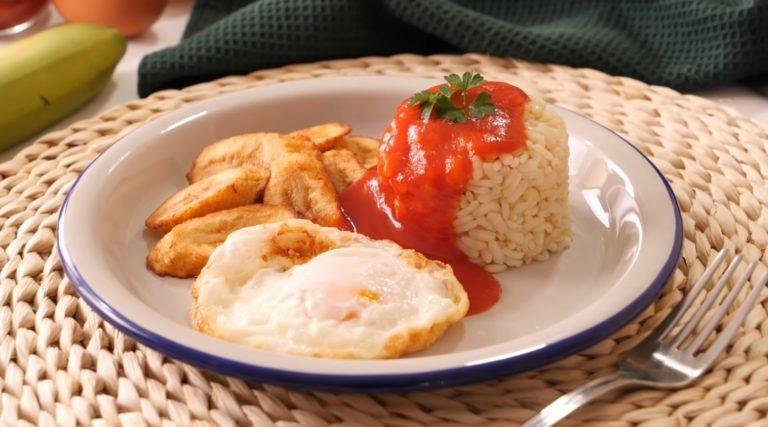
Cuban fried rice became its own dish. It starts from plain white rice cooked the day before. Ham and shrimp are the standard, often with roast pork or chicken as well, and the seasoning is garlic-forward in the way a Cuban cook uses garlic. Soy sauce goes in for salt and color, not for sweetness. It comes out drier and firmer than fried rice in a Chinese restaurant, and it lands beside black beans and fried plantains instead of standing as a course of its own. That plate is the clearest example of Chinese influence on Cuban food anyone can point at.
Two origin stories deserve honest handling. Fried rice is old in China and began as a way to use rice cooked the day before; the popular claim that it dates to the Sui dynasty is repeated far more often than it is documented. Chop suey is usually told as a New York invention improvised in 1896 for the visiting statesman Li Hongzhang. Historians dispute that. The better-supported account traces the dish to tsap seui, roughly “miscellaneous leftovers,” a real home dish in Taishan and the counties around it, which is exactly where most Chinese Cubans came from. It did not need inventing. It traveled.
1959, 1968 and the move north
Barrio Chino was still busy in the 1950s. Then the private economy closed. In March 1968 the Revolutionary Offensive nationalized more than 55,000 small businesses in a matter of weeks, every fonda, stall, laundry and lunch counter included. Chinese Cuban families left with the rest of the exodus, mostly for New York, northern New Jersey and Miami.
What they opened in exile was a genre of its own: the chino-latino restaurant, one menu with two halves. Ropa vieja on one page and lo mein on the other. Black beans and egg foo young. Café con leche at the counter. Manhattan had dozens, thick on the Upper West Side, in Chelsea and up in Washington Heights. La Caridad 78 opened at Broadway and 78th Street in 1968 and served for more than fifty years before closing in 2020. Most of its neighbors had gone first. The founders retired, the children became teachers and accountants, the rent went up, and the genre thinned to a handful of survivors such as La Dinastía on West 72nd.
Barrio Chino now
What is left in Havana is a few blocks. Calle Cuchillo is a short pedestrian alley of restaurants. A Chinese gate, the Pórtico Chino, went up on Dragones in 1999 with support from Beijing. The Casino Chung Wah, founded in 1893, still holds its building, and the Chinese-language paper Kwong Wah Po has been printed in the neighborhood since the 1920s. China-born residents are now counted in the low hundreds, and most of the cooks and waiters on Cuchillo have no Chinese ancestry at all. The neighborhood is a memorial that still sells lunch.
Chef’s notes
- Fried rice needs cold rice. Cook it a day ahead, spread it on a sheet tray and refrigerate it uncovered so the surface dries. Hot rice steams in the pan and turns to paste.
- Get the pan hot before anything touches it, and cook in batches. Crowding drops the heat and the rice boils instead of frying.
- Cook the egg on its own, break it up, and fold it back in at the end.
- Add soy sauce down the hot side of the pan in the last thirty seconds. Poured over the top early, it soaks in unevenly and the rice goes flat.
- Ham and shrimp are the Cuban standard. Diced ham does more work than any other single addition.
You can judge a Cuban kitchen by the plain rice, before anything is fried at all. Grains separate, no gumminess, no wet layer at the bottom of the pot. That is the base everything else is built on, and our white rice is made to be eaten with beans and with whatever sauce is on the plate. Meat rice comes from the older Spanish side of the family tree, where the grains take on the cooking liquid and the meat while they cook instead of being fried in fat afterward. Two rice traditions, two techniques, one island.
The men who landed in Havana in 1847 did not choose the voyage, and most never saw Guangdong again. Their cooking outlasted them, and it kept moving: out of the cane fields into the fondas, out of Barrio Chino into a hundred storefronts in New York, and onto Cuban tables that no longer remember where the soy sauce came from. Come eat with us at 5555 S 78th St in Tampa, look through the full menu, or call (813) 450-2176 to order for pickup. We open at 5am Monday through Friday.