
The Ybor City devil crab
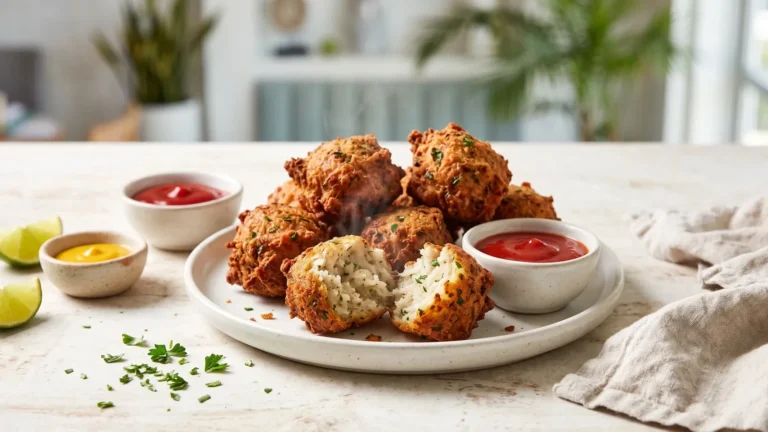
Hold one in your hand and the shape tells you what it is for. A devil crab is roughly the size of a fist, pointed at both ends like a small football, deep brown and slightly ridged from the fryer. It has no shell and no bone in it. You eat it walking, out of a paper bag, and if you are doing it properly you have hot sauce. In Tampa nobody says the second word of “deviled crab” clearly. It comes out as one word: devilcrab.
Inside is blue crab cooked down in a red sofrito. Around it is not batter and not béchamel but bread. Day-old Cuban bread, soaked in water or broth, squeezed out and ground into a dense paste, sometimes cut with fine cracker meal, tinted red-orange by tomato and paprika. That paste is molded around the crab filling like clay, rolled in more crumbs, and dropped in hot oil. The result is soft and dense at the center and crackling at the edges, which is a texture almost nothing else in American food has.
Where it comes from geographically is not in doubt
Ybor City was founded in 1885 and 1886 by Vicente Martinez Ybor, a Spanish-born cigar manufacturer who had run factories in Havana and then Key West before buying scrubland northeast of Tampa and building a company town on it. Tampa annexed the place in 1887. Within a generation it held Cuban, Spanish and Sicilian families, along with smaller communities of Germans, Romanian Jews and African Americans, and the cigar factories were turning out hundreds of millions of cigars a year at their peak in the 1920s.
The town organized itself around mutual aid societies that pooled dues and provided medical care: El Centro Español, El Centro Asturiano, the Círculo Cubano, L’Unione Italiana. Inside the factories, workers paid out of their own wages for a lector, a reader who sat on a platform and read the newspapers in the morning and novels in the afternoon while several hundred people rolled cigars in silence. That system ended after the strike of 1931, when owners removed the readers for good. The district was designated a National Historic Landmark in 1990.
The devil crab belongs to that place and that period. What is not settled is how it got there.
The strike account
The story most often told in Tampa is that the devil crab was invented during a cigar workers’ strike in the 1920s, most tellings pointing to the long walkout that began in 1920 and dragged on for the better part of a year. Wages stopped. Blue crab in Tampa Bay was free for anyone with a trap and a boat, and Cuban bread going stale on a bakery shelf was close to free too. Put the two together and you have hot food that costs almost nothing, travels in a bag, and feeds a picket line.
Part of that account names a man. Francisco Miranda is remembered in the local record as selling deviled crabs around Ybor from a bicycle, carrying them to workers and to the crowds outside the factories, and some retellings credit him with the invention itself. The Miranda name has stayed attached to devil crabs in Tampa commerce ever since. This is reported history rather than documented history: it comes down through families, newspaper features and oral accounts, not through a dated record made at the time. That does not make it false. It does mean it should be repeated as what it is.
The croquette account
The competing explanation is less dramatic and needs no strike at all. Croquettes came out of French cooking in the nineteenth century, were taken up enthusiastically in Spain, and traveled to Cuba with Spanish families, where the croqueta de jamón became an everyday item. The Spanish and Cuban households that filled Ybor City were already frying croquettes when they arrived. Seen that way, the devil crab is simply what happens when an established form meets a local ingredient: the crab is what Tampa Bay had in quantity, and the bread shell is what a household with day-old bread and no money for béchamel would reach for.
There is a third thread, and it concerns the name rather than the food. “Deviled” is an English-language cooking term, used since the eighteenth century for anything sharply seasoned — deviled eggs, deviled ham — and deviled crab, meaning crab meat baked hot in its own shell, was on American restaurant menus well before Ybor City existed. So the Ybor version may have taken an English name from the city around it and applied it to something structurally unrelated. The object could be Spanish and Cuban while the label is Anglo-American.
No contemporaneous document has surfaced that settles which account is correct, and the accounts are not fully exclusive. A croquette tradition already in the neighborhood and a strike that made cheap portable food urgent could easily be two halves of the same event. Anyone who tells you flatly that the devil crab was invented on a particular day by a particular person is going further than the evidence goes.
The crab and the bread
What both accounts agree on is the frugality. Blue crab, Callinectes sapidus, was abundant in Tampa Bay and cheap enough that families caught their own. Picking crab is slow, tedious work that yields a small amount of meat for a lot of effort, which is exactly why the meat gets stretched into a filling rather than served on its own. A pound of picked crab makes a lot of devil crabs.
The bread half is the same logic. Cuban bread in Tampa is lean, made with lard, and it goes hard by the second day, which is why the neighborhood found a use for yesterday’s loaves rather than throwing them out. La Segunda Central Bakery has been baking that bread in Ybor City since 1915, still run by the same family, and the palmetto frond laid across the loaf to split the crust is still part of how it is done. Day-old bread was never garbage in that neighborhood. It was raw material for bread pudding, for torrejas, and for this.
What survived
The cigar industry collapsed, mechanization and the Depression took most of the factories, and Ybor City spent decades hollowed out before it came back as a historic district and a nightlife strip. The devil crab did not go away with the factories. It stayed in family kitchens and moved out to counters, corner stores, gas stations and the Saturday market at Centennial Park, which is one of the few foods that made that transition on its own strength rather than through restaurants.
It also stayed regional in a way almost nothing does now. Drive an hour in any direction from Tampa and the devil crab disappears. It never scaled, never got franchised, never appeared on a national menu. It is one of the last genuinely local foods in Florida, and it is local because it was made out of exactly what one neighborhood had too much of: crab, stale bread, and people who knew how to fry.
Kiki’s is a Cuban kitchen a few miles from Ybor, at 5555 S 78th St in Tampa, and we cook out of the same tradition of frying and stretching that produced the devil crab. If you want the closest relatives on our side of town, start with the croquettes and the pastelitos, then look through the rest of the menu.