
Are Plantains Just Big Bananas?
Set a banana next to a plantain and the plantain looks like the same fruit that kept growing: longer, thicker, more angular, with skin that does not want to come off. The resemblance is real. The difference that matters is not size. It is starch.
The same genus, a different job
There is no botanical border between bananas and plantains. Both belong to the genus Musa, and nearly every one you have eaten traces back to two wild Southeast Asian species, Musa acuminata and Musa balbisiana. Farmers crossed and re-crossed them for thousands of years. The sweet yellow banana in American supermarkets is the Cavendish, built almost entirely from acuminata. True plantains carry genes from both parents. Botanists write the sweet ones as AAA and the plantains as AAB, counting how many chromosome sets came from each wild ancestor.
Both are sterile triploids, cloned from suckers rather than grown from seed. Wild bananas are the opposite: full of hard black seeds and barely worth eating. Two more details are true and beside the point: bananas are berries, and the plant is not a tree but a giant herb whose trunk is a tight roll of leaf sheaths.
So plantain is a kitchen word, not a scientific one. It marks a cooking banana, bred for starch and body instead of sugar and softness. Language keeps the confusion going. In Cuba, plátano covers the whole family and you add a second word to say which one you mean: plátano burro or plátano vianda for the cooking kind, plátano fruta for the sweet one. In Puerto Rico, guineo is the sweet banana and plátano is the plantain. English is the odd one out for treating them as two separate fruits.
They live different commercial lives too. Dessert bananas are an export crop grown from a handful of clones, which is why one fungal disease could take down the old Gros Michel variety and push the industry to Cavendish through the 1950s and 1960s. Plantains are mostly grown and eaten close to home, above all in West and Central Africa.
Starch is the whole difference
A green plantain is around a third starch by weight and holds almost no sugar. A ripe dessert banana has flipped the ratio: starch down to a few percent, sugar up around 15 to 20 percent. Both fruits make the same trip: ethylene gas triggers enzymes that cut stored starch into sugar. The plantain simply starts with far more starch, takes far longer to convert it, and keeps some body even at the end of the ride.
The numbers follow the starch. USDA figures put raw plantain near 120 calories per 100 grams against about 90 for a banana, with roughly 30 grams of carbohydrate to the banana’s 23, and close to 500 milligrams of potassium against about 360. A green plantain is also high in resistant starch, the kind that passes through the small intestine undigested, which is why green plantain flour turns up in health food aisles.
Why a green plantain cannot be eaten raw
Nothing in a green plantain is poisonous. It is simply useless raw, for three reasons.
First, the starch. Raw starch sits locked inside tight, semi-crystalline granules that human amylase can barely get at. Heat plus water breaks those granules open, a process called gelatinization, which for banana starch happens somewhere around 65 to 75 C, roughly 150 to 170 F. Below that the flesh stays chalky and most of the starch travels straight through you.
Second, tannins. An unripe plantain is astringent and dries the mouth the way an unripe persimmon does. Those compounds bind up as the fruit ripens, and heat breaks them down.
Third, the sap. Cut into a green plantain and the peel leaks a sticky latex that stains hands, knives and cutting boards rusty brown and does not rinse off easily.
Cooking answers all three at once. That is why every green plantain dish in the Caribbean is fried, boiled, roasted or mashed: tostones smashed and fried twice, mariquitas sliced thin as paper, fufu mashed hot with garlic and pork fat, mofongo across the water in Puerto Rico.
Green to black, and what each stage is for
A plantain on the counter takes roughly a week to ten days to go from hard green to full yellow, and several days more to turn black. Each stage has its own dish.
- Hard green, pale flesh, no give at all. Peak starch, no sweetness. This is tostones and chips. The flesh fries firm and the edges shatter.
- Green with yellow starting at the tips. Still starchy, slightly softer. Best boiled, dropped into soup, or boiled and then mashed into fufu.
- Full yellow, firm under the thumb. The awkward middle. Sweet enough to brown, starchy enough to hold its shape. Boil it, roast it, or fry it and accept a mild result.
- Yellow with black spots, gives under a light press. Maduros. Enough sugar to caramelize into dark edges while the center stays soft and intact.
- Black all over, soft, skin loose. The sweetest it gets, close to jam. Fry it gently or bake it, as in plátanos en tentación, cooked down with sugar, butter and cinnamon.
Here is the part that trips up newcomers. A black banana is compost. A black plantain is the best one in the bunch.
How the plantain reached the Cuban table
Bananas and plantains were domesticated a long way from the Caribbean. The oldest firm evidence for cultivation comes from Kuk Swamp in the highlands of Papua New Guinea, where drainage ditches and banana phytoliths date to roughly 7,000 years ago. From there the plant moved west across the Indian Ocean and into Africa. When exactly is disputed: phytoliths from Nkang in Cameroon place cooking bananas in West Africa around 2,500 years ago, while an older claim from Munsa in Uganda has been challenged by other archaeologists and is not settled.
The Atlantic crossing is better documented, though not airtight either. The Spanish chronicler Gonzalo Fernández de Oviedo wrote in 1535 that the friar Tomás de Berlanga carried plantain roots from the Canary Islands to Hispaniola in 1516. That account is the one everyone cites, though it records one shipment rather than proving a first arrival. From Hispaniola the plant spread through the islands quickly, because it suits the climate and yields year round. In Cuba it settled in as a vianda, the category of starchy staples that also holds yuca, malanga and boniato.
The names traveled oddly too. Banana came into English through Spanish and Portuguese from a West African language. Plantain came through the Spanish plátano, usually traced to the Latin platanus, the plane tree, though that derivation is argued and some scholars point to a Carib word the Spanish adapted. The plantain that grows as a weed in lawns, Plantago, is an unrelated word, from the Latin for the sole of the foot.
Chef’s notes
- Peel green ones with a knife. Cut both ends off, score the skin lengthwise along the ridges three or four times, cutting only through the peel, then work it off in strips with your thumb. Wipe your hands and the blade with oil first and the sap will not stain.
- Use salted water. Soak peeled green rounds in salted water for ten minutes before they go in the oil. It seasons them through and they take on less fat.
- Fry green plantains at two temperatures. Around 325 F first to cook the inside through, then smash them flat and go back in near 375 F for the crust. One temperature gives you either a raw center or a burnt outside.
- Fry ripe ones cooler. Maduros want 325 to 350 F. Sugar browns fast, and at high heat the outside is black before the middle turns soft.
- Salt tostones the second they leave the oil. The surface is still wet and the salt sticks. A minute later it slides off.
- Do not refrigerate a green plantain. Cold stalls the ripening and blackens the skin without sweetening the inside. Leave it on the counter, and if you need it ripe sooner, close it in a paper bag with an apple or a banana to trap the ethylene.
- Buy on a schedule. Green today gives you maduros by the weekend. If you want tostones tonight, buy them hard green and cook them tonight.
What to do with all this at the table
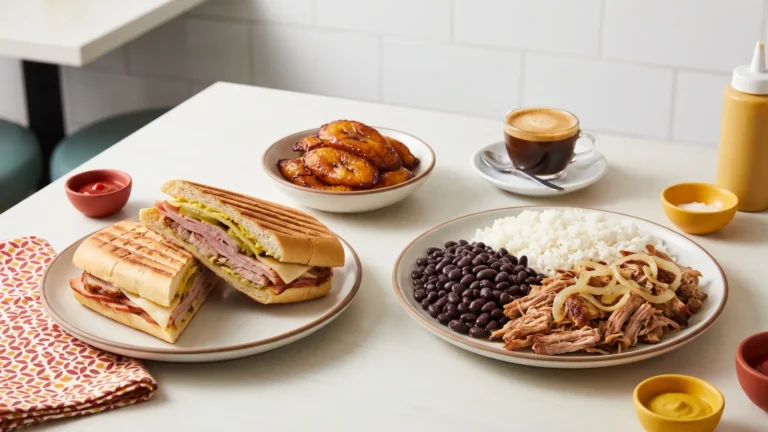
You do not need any of it to order well, but the two versions arrive as different foods. Green means savory, firm and salted, eaten with your fingers. Ripe means dark sweet edges next to something salty, the way black beans and rice or a plate of roast pork asks for it.
If the banana is the only Musa you have eaten, plantains are an easy way into Cuban food: same family, grown for the pan instead of the lunchbox. Look through the rest of the menu and build a plate around them.