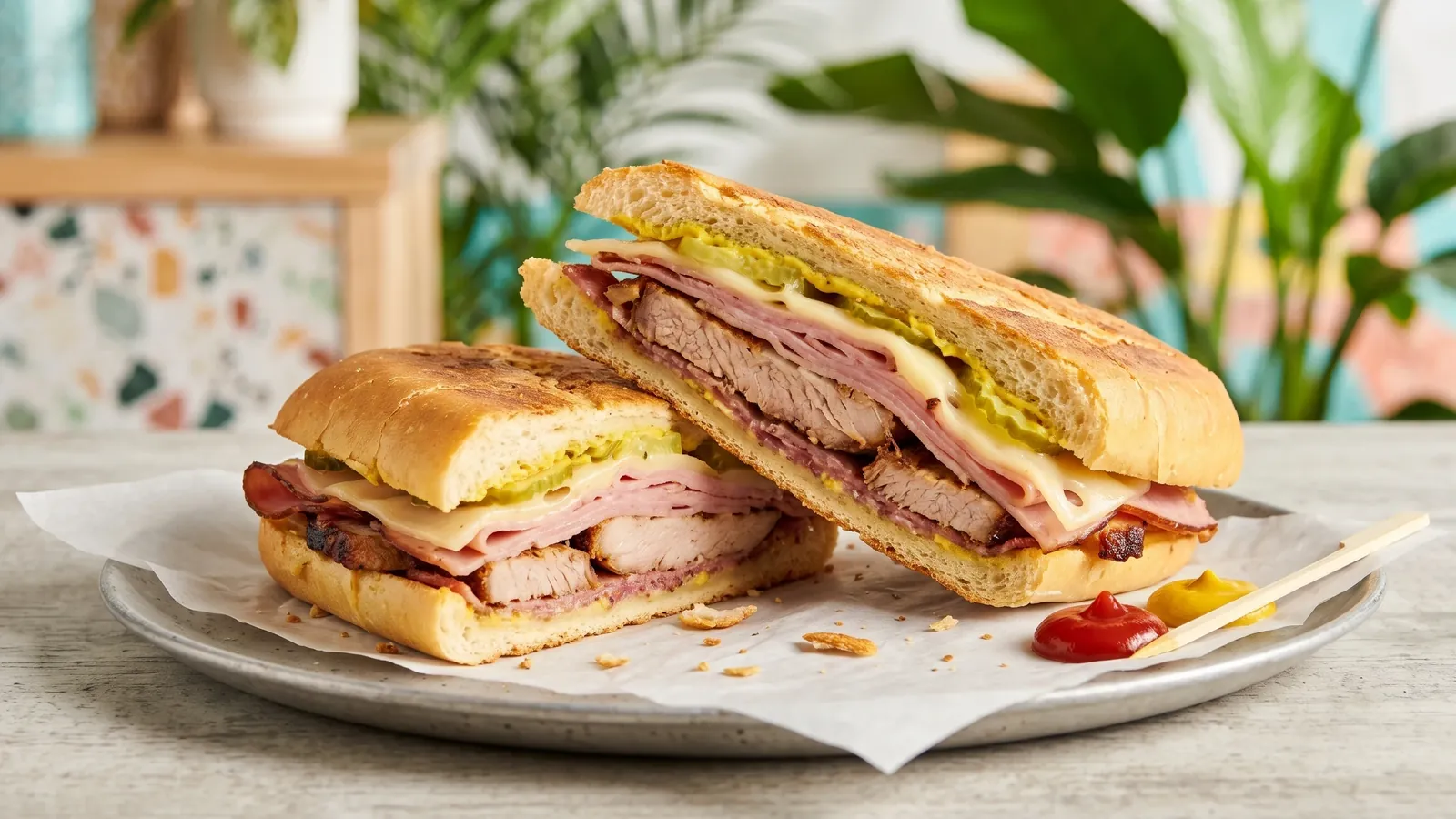
Why a Real Cuban Sandwich Has No Mayo, Lettuce or Tomato
Somebody asks this at the counter most weeks, usually a little sheepishly, so let’s settle it in public. Does a Cuban sandwich have mayo? No. It does not get lettuce or tomato either. That is not snobbery, and nobody here is going to look at you sideways for asking. There is a mechanical reason behind every one of those omissions, and once you know what happens to a sandwich under a hot iron, the rules stop feeling like rules.
The short list of what actually goes in
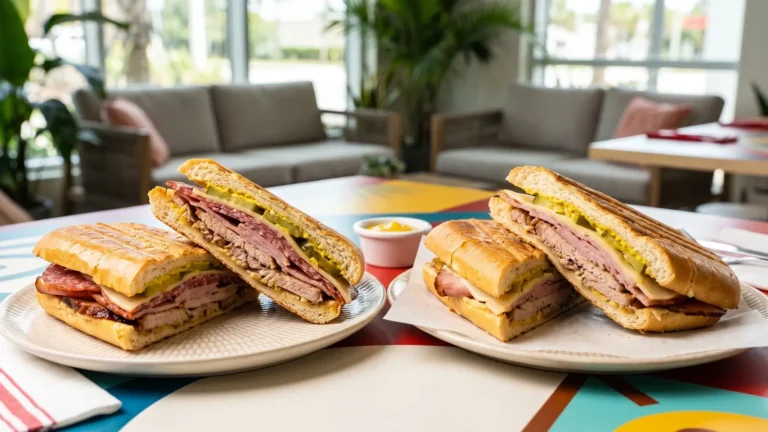
Cuban bread, split lengthwise. Yellow mustard on both cut faces. Roast pork. Sliced ham. Swiss cheese. Dill pickles. In Tampa, a slice or two of Genoa salami usually joins the stack. Then the whole thing goes on the plancha and gets flattened under heat until the cheese runs and the crust crackles.
Six or seven ingredients. Each one has a job, and each one can survive being cooked flat at around 350°F for three or four minutes. That last part is the filter. It is the entire reason the list is short. A Cuban sandwich is not a cold sandwich that happens to be warm.
A press is a cooking method, not a shortcut
Toasting is drying. Bread turns crisp because water leaves its surface faster than the inside can resupply it. As long as there is free water anywhere in the sandwich, that water boils, turns to steam and pushes back into the crumb. Steam and crust are opposites. A sandwich that steams comes out pale, soft and heavy no matter how long you leave it on the heat.
The real question for any ingredient, then, is not whether it tastes good. It is how much water it carries, and where that water goes when it gets hot.
Lettuce and tomato are mostly water
Iceberg lettuce runs about 96 percent water. A tomato is roughly 94 percent. Those numbers are an asset on a cold sandwich, where they read as crunch and juice. Under a press they are a small flood.
Lettuce goes first. The cell walls give out, the leaf wilts to a dull olive color, and what was crisp becomes a thin slick layer between the meat and the bread. That layer is slippery, so the filling slides sideways with every bite and lands on the paper. Cooked lettuce also smells faintly of cabbage, which is not what anyone came in for.
Tomato is worse, because the gel around the seeds is loose water with nowhere to go but into the crumb. The bottom face of the bread turns to paste, the mustard gets diluted into pink nothing, and the sandwich sags in the middle when you pick it up.
Mayonnaise separates before the cheese even melts
Mayonnaise is an emulsion: oil broken into microscopic droplets and held suspended in a little water and vinegar by the lecithin in egg yolk. Commercial mayo is roughly three quarters fat by weight. That arrangement is stable at room temperature and fragile at griddle temperature. Heat gives the droplets enough energy to find each other and merge, so the emulsion splits well before Swiss cheese has softened. You get an oily seam running out one side of the sandwich and a thin watery one running out the other.
There is a flavor problem under the physics problem. Roast pork, ham and melted cheese are all rich. Richness needs acid to cut it, which is the entire purpose of the mustard and the pickles. Mayo is fat with a whisper of acid in it. Adding it to a Cuban is adding fat to fat and hoping something balances.
And there is a third issue nobody thinks about. Melted cheese is the glue that holds the layers into one object. A film of oil between the bread and the filling stops the cheese from bonding to the crumb, and the sandwich comes apart in your hands instead of cutting clean.
The order of the layers is doing work too
Cheese goes against the bread, not in the middle. It melts into the open crumb and welds the stack together, and the fat it gives off helps the inner face toast instead of steam. The pickles go in the center, insulated by meat on both sides, as far from the bread as the sandwich can put them. That is not decoration. It is water management.
Why pickles get in and tomatoes do not
This is the fair objection, and it has a real answer. Pickles are wet too, but they have already been through something a tomato has not. Brine is salt, and salt pulls water out of the cucumber’s cells and replaces it with a salted, acidified liquid. What is left is firm rather than juicy. Sliced thin and laid flat, four or five chips give up very little liquid, hold their shape under compression, and deliver acid that gets sharper as it warms rather than washing out.
Yellow mustard passes the same test. It is mostly vinegar, water, ground mustard seed and turmeric, with essentially no fat in it to break. Spread in a thin coat on the cut bread, it seasons the whole sandwich, and the vinegar concentrates slightly under heat instead of thinning.
The bread was built for the press
Tampa Cuban bread is a long, pale loaf with a thin brittle crust and an open, dry crumb, traditionally made with lard. Bakers lay a damp palmetto frond along the top of the loaf before it goes in the oven, which is what leaves the seam down the middle of the crust. La Segunda Central Bakery in Ybor City has been turning it out since 1915.
That structure is not an accident. A dry, airy crumb collapses under the iron into thin flat layers and crisps all the way through, and a thin crust shatters when you bite it instead of tearing. Lay a wet vegetable against that crumb and you have undone every decision the baker made.
Every version of the argument agrees on this much
Tampa puts Genoa salami in the sandwich, a habit traced to Ybor City, where Italian immigrants lived and worked alongside Cuban and Spanish cigar workers. Miami leaves it out. Where the sandwich was first assembled is genuinely disputed, and both cities have been enjoying that fight for a century.
Notice what none of it touches. Havana or Key West, Tampa or Miami, salami or no salami, nobody in any camp has ever argued for mayonnaise, lettuce or tomato. On the one point this article is about, every side of every argument already agrees.
The medianoche follows the same rules
Same filling, different bread. A Cuban midnight sandwich uses a soft, faintly sweet egg-and-butter roll instead of the crusty loaf. The name means midnight, and the usual explanation is that it was what people ate when the clubs and dance halls in Havana let out. Sweet bread against sharp mustard and pickle is the whole point of it.
It presses shorter and lower, and the sugar in the dough browns faster, so it comes off the heat sooner. If lettuce and tomato hurt a Cuban sandwich, they do more damage here. That soft roll has no structure to spare, and it goes from tender to sodden in under a minute.
Chef’s notes: what we will and will not do if you ask
- Mayo: yes. Ask for it and it goes on the bread before the press. It is your sandwich and your money, and we would rather you ask than eat something you did not want. Now you know what it does in there.
- Lettuce and tomato: on the side, in a separate container, never under the iron. Open the sandwich when it reaches you and lay them in yourself. That way you get the crisp crust and the cold crunch. Pressed together, you get neither one.
- Pickles: hold them or double them, no consequence either way. Same with extra mustard, which is the one ingredient that improves under heat.
- Taking it home: eat it inside fifteen minutes if you can. If you cannot, reheat it in a dry skillet or a press over medium heat, about two minutes a side. Do not microwave it. A microwave works by exciting water molecules, which is precisely the thing this sandwich is built to avoid.
- If mayo, lettuce and tomato are what you actually want, order the BLT instead. It is built cold, meant to be eaten cold, and none of it fights you.
None of this is a test and there is no wrong order. A pressed sandwich is cooked food, and cooked food answers to heat and water like everything else on the griddle. Come see how it holds up. The full menu is online for pickup, and if you want the lettuce and tomato, say so and we will box them separately.