
Where the Cuban Sandwich Actually Came From: Havana, Key West or Ybor City
Ask who invented the Cuban sandwich and you get three answers, each delivered with total confidence. Havana. Key West. Ybor City. Every version arrives with a date, a cafe and sometimes a founder attached, and almost none of it survives contact with an archive. The documentary record for this sandwich is short, uneven, and silent in exactly the places you want it to speak. What follows is what the record actually holds, and where it stops.
This is the origin question only. The other Cuban sandwich argument, the one about whether Genoa salami belongs in it, is a Tampa-versus-Miami fight and we handled it separately in the Cuban sandwich argument, Tampa versus Miami.
The earliest printed mention comes from Tampa
The most serious work on this belongs to Andrew Huse, a librarian and historian at the University of South Florida, whose Special Collections hold much of what survives of Ybor City’s cigar era. Huse spent years in Florida newspaper files, city directories and business records. In 2022 he published The Cuban Sandwich: A History in Layers with Barbara Cruz and Jeff Houck through the University Press of Florida. It is the closest thing anyone has to a documented account.
The oldest printed use of the phrase that researchers have surfaced is a passing line in the Tampa Tribune in 1906. It is a mention, not a description. Nobody stops to explain what a Cuban sandwich is, which is the useful part: the writer assumed the reader already knew. A term that shows up in print unexplained has usually been spoken for a while first.
So 1906 fixes one thing. By that year, in Tampa, the sandwich had a name that people recognized without help. It does not tell you where it was first assembled, by whom, or what went between the bread.
One more caveat belongs here. “Earliest known” is a statement about what has been digitized and indexed, not about what happened. Long runs of Florida’s Spanish-language and neighborhood papers were discarded, burned or never microfilmed. A single surviving menu could move the date next year.
Havana had the sandwich before it had this name
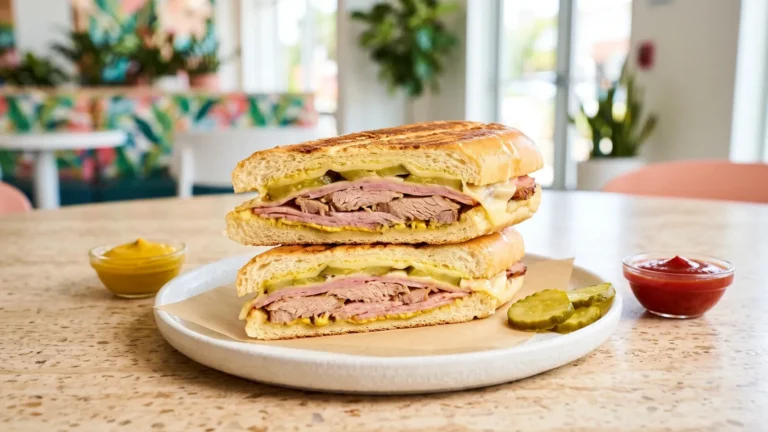
In Cuba the thing itself is a mixto. Ham and roast pork with cheese, pickle and mustard on a long loaf, flattened on a hot plate. “Cuban sandwich” is a mainland name applied from outside, the way Danish pastry is not what anyone calls it in Denmark.
Havana also had every component first. Spanish immigration brought cured ham. Roast pork sits at the center of Cuban cooking. Cheese and cucumber pickles came through the port. Cafes already worked a hot press for other sandwiches. If you are looking for the parts, they were sitting on the same counter in Havana before they were anywhere in Florida.
What Havana does not have is a stronger paper case. The mixto was cafe and street food, sold to people eating standing up, and that kind of eating leaves almost no trace. Cuban menus and cookbooks from the nineteenth century are scarce, and the ones that survive record formal dining rooms. Researchers hunting for early Cuban print references to the sandwich have not produced anything that clearly predates the Florida mentions.
The relative with a firmer address is the medianoche, the same general fillings on soft sweet egg bread, named for the hour when Havana’s clubs and theaters emptied out and people wanted something before going home. Its Havana origin is far less contested.
Key West’s claim is chronology without paper
Cuban cigar workers were in Key West a full generation before Ybor City existed. The Ten Years’ War, from 1868 to 1878, pushed people and capital off the island, and Vicente Martinez Ybor moved his own cigar operation from Havana to Key West in 1869. Through the 1870s and into the 1880s, Key West was the largest cigar-making city in the United States and one of the most Cuban towns in North America.
Those workers ate at counters run by their neighbors. If the mixto crossed the ninety miles of water, Key West is the first place it could have landed. The argument is sound, and Key West makes it often.
It is also, so far, an argument from chronology rather than from documents. No dated Key West menu, advertisement or captioned photograph has come forward that puts the sandwich there ahead of the Tampa mentions. A town that burned in 1886 has a fair excuse for holes in its record, but an excuse is not evidence.
Ybor City is where it entered the record
Ybor bought land northeast of Tampa in 1885 and opened his first factory there in 1886, the same year fire tore through Key West’s cigar district. The fire and years of labor conflict together moved a large part of the industry north.
What grew around those factories matters more than the factories. Ybor City filled with Cubans, Afro-Cubans, Spaniards and Sicilians living on the same blocks, with mutual aid societies, Spanish-language papers, cafes on the corners, and lectors reading newspapers and novels aloud over the rolling tables, a practice carried straight from Havana. Thousands of people broke for lunch at the same hour and needed something hot, cheap and fast.
That is the setting the printed mentions come out of, and it explains the pattern. Tampa had a daily English-language paper covering a Latin working-class neighborhood at close range. The counters in Key West and Havana had no equivalent observer writing them down.
Tampa built the supply chain too. La Segunda Central Bakery opened in Ybor City in 1915 and has produced the long, thin-crusted loaf ever since. Tampa bakers lay a palm frond along the top of the dough so the crust splits along a seam as it bakes. In 2012 the Tampa City Council passed a resolution naming the historic Cuban sandwich the signature sandwich of the city, which is a civic decision rather than a finding of fact. The two are worth keeping apart.
Why the question stays open
Three problems keep anyone from closing it honestly.
- Working food is close to invisible. Newspapers covered banquets and hotel dining rooms. What a cigar roller ate standing up on a short break was not news.
- Names lag food. The first printed appearance of a phrase marks the moment writing caught up, not the moment cooking started. That gap runs to decades.
- The three cities were one community. Henry Plant’s steamers linked Port Tampa to Key West and Havana from the late 1880s, and the Peninsular and Occidental line worked the route for decades after. Families, wages, tobacco, newspapers and recipes moved on the same boats in both directions, constantly. Asking which port invented the sandwich is close to asking which end of a street invented the street.
What would actually settle it
A dated menu. A cafe advertisement in a Spanish-language paper. A photograph of a price board. A bakery ledger listing sandwich loaves. Something with a year on it, from Key West or Havana, earlier than 1906. Archivists at USF and elsewhere are still looking, and material does surface. Until it does, the accurate answer to who invented the Cuban sandwich is that no single person did, and that the sandwich came out of the Havana, Key West and Tampa corridor rather than out of one kitchen inside it.
Chef’s notes
The history is unsettled. The definition is not, and it is narrow.
- Cuban bread, not a baguette and not a hoagie roll. Thin brittle crust, light crumb, so it compresses under the press instead of fighting back.
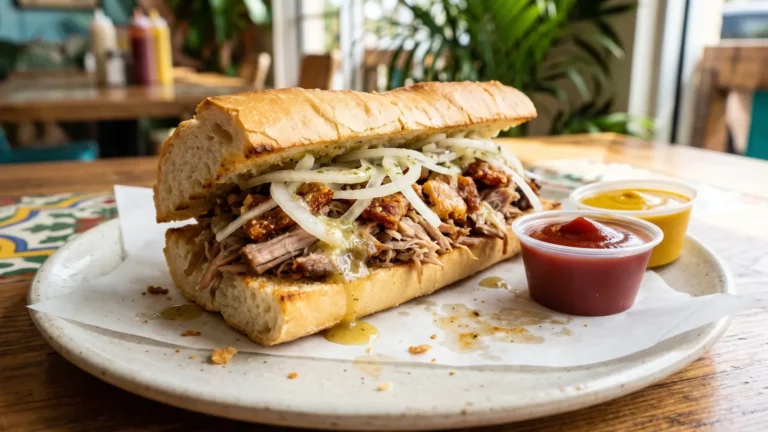
- Roast pork and sweet ham together. Pork alone is pan con lechon; ham alone is a ham and cheese. The pair is what makes it a Cuban.
- Swiss cheese, dill pickle, yellow mustard. No lettuce, no tomato, no mayonnaise. That is not a house rule, it is the definition.
- Pressed until the loaf is around a third of its original height, the crust marked and blistered, the cheese binding the layers so the cut face holds together instead of sliding apart.
Two practical points for pickup orders. Unwrap the sandwich as soon as you get home, because trapped steam softens a crisp crust in a few minutes. And eat it hot. A pressed sandwich has a short window, and reheating never gives back the crust it had coming off the plancha.
The origin question is unlikely to be closed in our lifetime, and the sandwich is indifferent to it. What nobody disputes is the build: Cuban bread, roast pork, sweet ham, Swiss, pickle, mustard, pressed flat. That is the Cuban sandwich we serve, with the medianoche beside it for anyone who prefers the softer bread. The rest is on the full menu, and you can order ahead for pickup at 5555 S 78th St in Tampa or call (813) 450-2176.